
Tensas VINE and LAVNS Coverage
Louisiana calls its automated service the Louisiana Automated Victim Notification System, or LAVNS. VINELink provides the online person search. Tensas participation is local and visible: the agency-branded Tensas LAVNS jail roster displays a custody-change registration prompt above the current population. Louisiana DPS&C also directs the public to VINELink and says its information includes people in prison and people under probation or parole supervision.
Coverage does not make every record equivalent. The Tensas roster is a current parish-facility feed. A DPS&C result may reflect state imprisonment or community supervision. A person may also transfer between custodians. Read the agency and status together. “Transfer” is not release to the community, and a supervision result is not proof of full discharge.
Federal custody sits outside this path. The Bureau of Prisons and ICE maintain separate locators, while the U.S. Marshals Service has no broad public locator like BOP. A Tensas jail departure to one of those agencies should be followed through the receiving system named in the release record.
Search Tensas Inmates on VINE
Search one person at a time. Use the legal name or an identification number, then compare more than the name. Date of birth, age, DPS&C number, and reporting agency can separate people with similar names. The current interface may permit partial-name or partial-ID searching, but a broad search increases the chance of a wrong match. Do not use a photograph alone as proof of identity.
- Open the Louisiana person search and confirm that Louisiana is selected.
- Enter the full first and last name or a known identifier.
- Narrow results and compare birth date, age, agency, and DPS&C number when shown.
- Open the match and note exact status, location, reporting agency, dates, and update time.
- If more than one record could match, confirm with another identifier.
- If no record appears, contact the believed facility or DPS&C rather than declaring release.
The search is strongest for current or recent status. A past parish release may require the sheriff's retained booking and release record. A completed state discharge may require a focused DPS&C request. The Tensas Parish release search places those older-record routes in the full custody chain.
The official VINELink help and notification entry can be reviewed at its source page.
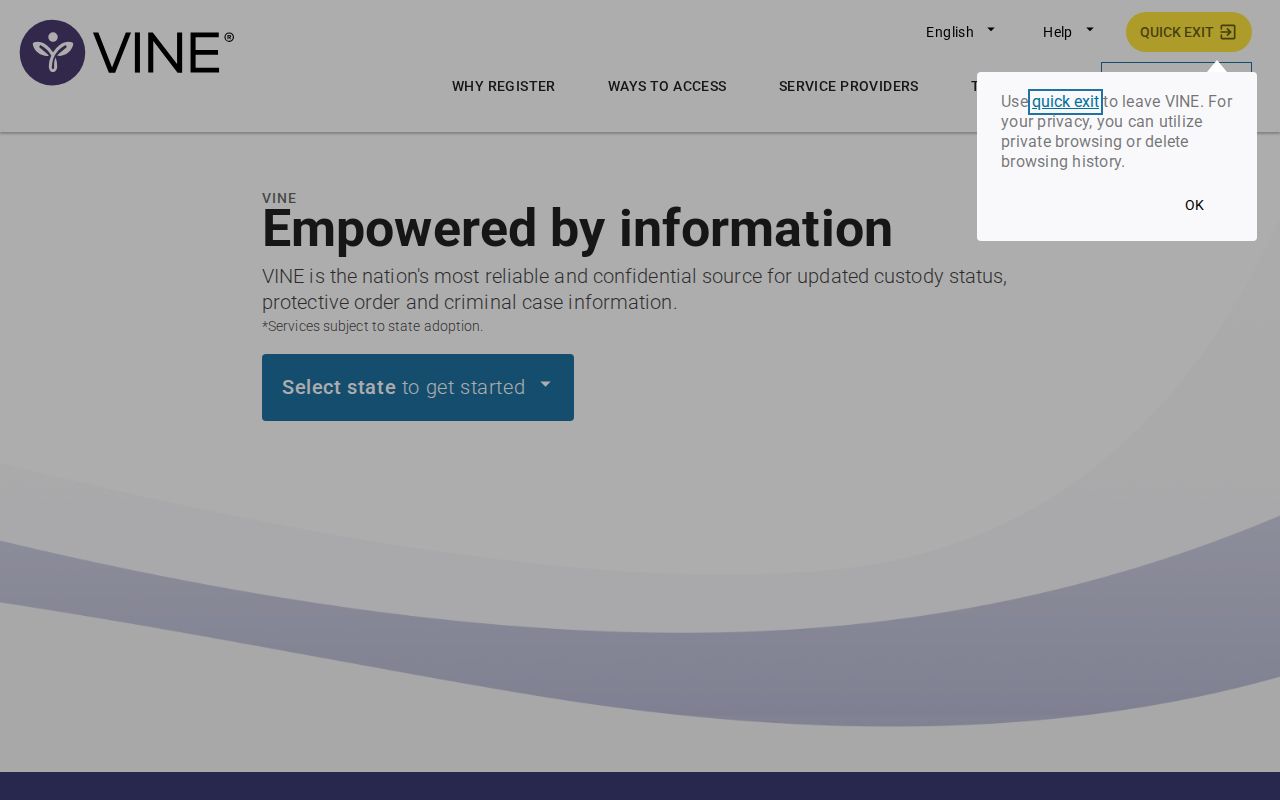
The captured page demonstrates the entry point, while live labels should govern each current search and registration.
Tensas VINE Release Result Fields
A matched card can show different fields based on the agency feed and status. Record only what the screen displays. Photos are optional. Recently released records may remain for a time, while an archived record may no longer accept tracking. No official universal retention window was found, so an old record's absence cannot establish when custody ended.
| Field | What it helps confirm |
|---|---|
| Name and identifier | Whether the record belongs to the intended person |
| Reporting agency | Which jail, corrections body, or supervision source supplied data |
| Status | The interface's current custody, release, or supervision wording |
| Location | The facility or community-supervision context when supplied |
| Status dates | Dates tied to the displayed event, not a full court history |
| Update time | When the feed says the information was refreshed |
A released result should be described with the exact interface term and date, if shown. “Released,” “out of custody,” parole, and probation do not mean the same thing. A projected date concerns a person still serving a sentence; it is not proof that the person left custody on that date.
Register Tensas VINE Release Alerts
Registration begins from the matched person record. Merely watching or saving a person is not the same as completing notification registration. Current methods may include email, text, telephone, or in-app notice. VINE recommends more than one method when available. The live interface controls because options can change.
- Open the correct record and choose the notification or “Get notified” control.
- Select one or more delivery methods currently offered.
- Enter and confirm the phone number, email address, or app details.
- Create the four-digit PIN when requested and avoid an easy-to-guess number.
- Complete any text, email, telephone, or account confirmation shown.
- Save the registration information and keep delivery details current.
For telephone calls, the recipient uses the chosen four-digit PIN followed by the pound key to confirm receipt. The PIN can also matter when managing a registration. It is not an inmate identifier. Other channels may use a link, code, account, or stored registration. Retain the confirmation so a failed notice can be traced.
A notice relays an agency-fed change. Read whether it reports release, transfer, escape, death, parole, or another event. Then confirm urgent or legally important details with the reporting agency.
Tensas Roster Notification Layer
Tensas has a distinctive local path beyond the national homepage. Its LAVNS subdomain places an anonymous custody-change registration prompt directly above the current jail population. Registration can begin while the person is still listed. The roster also gives an A-to-Z filter and a last-updated Central Time stamp, which helps date the observation.
The roster is still a current-custody view. It has no labeled releases tab, historical archive, or promised post-release window. A missing name cannot be turned into a release finding. Save the observation time, check any notice, and ask Tensas Parish Detention Center for the release event or destination if the name disappears.
The roster's terms also counsel against copying or republishing named records and photographs. Link to the interface and rely on the underlying sheriff record when an authoritative release event is needed. Current detainees should never be presented as released people.
Tensas LAVNS and LAVO Difference
Louisiana has two notice routes that should not be merged. DPS&C Crime Victim Services describes LAVNS/VINELink as the automated justice-status service and lists a 24-hour toll-free route at 866-528-6748. Louisiana Victim Outreach, or LAVO, is a separate direct-registration process for eligible directly affected people. The state says LAVO registration is presently needed for notices about a state imprisoned person's projected release date, actual release, and other listed actions. Its toll-free number is 888-342-6110.
Clicking the local Tensas LAVNS control does not guarantee every state-prison projected-date or actual-release notice. The local registration follows the participating jail feed. If the person later enters DPS&C custody and the reader qualifies for LAVO, use the separate state process.
The official source illustrates this division between automated notification and direct state outreach.
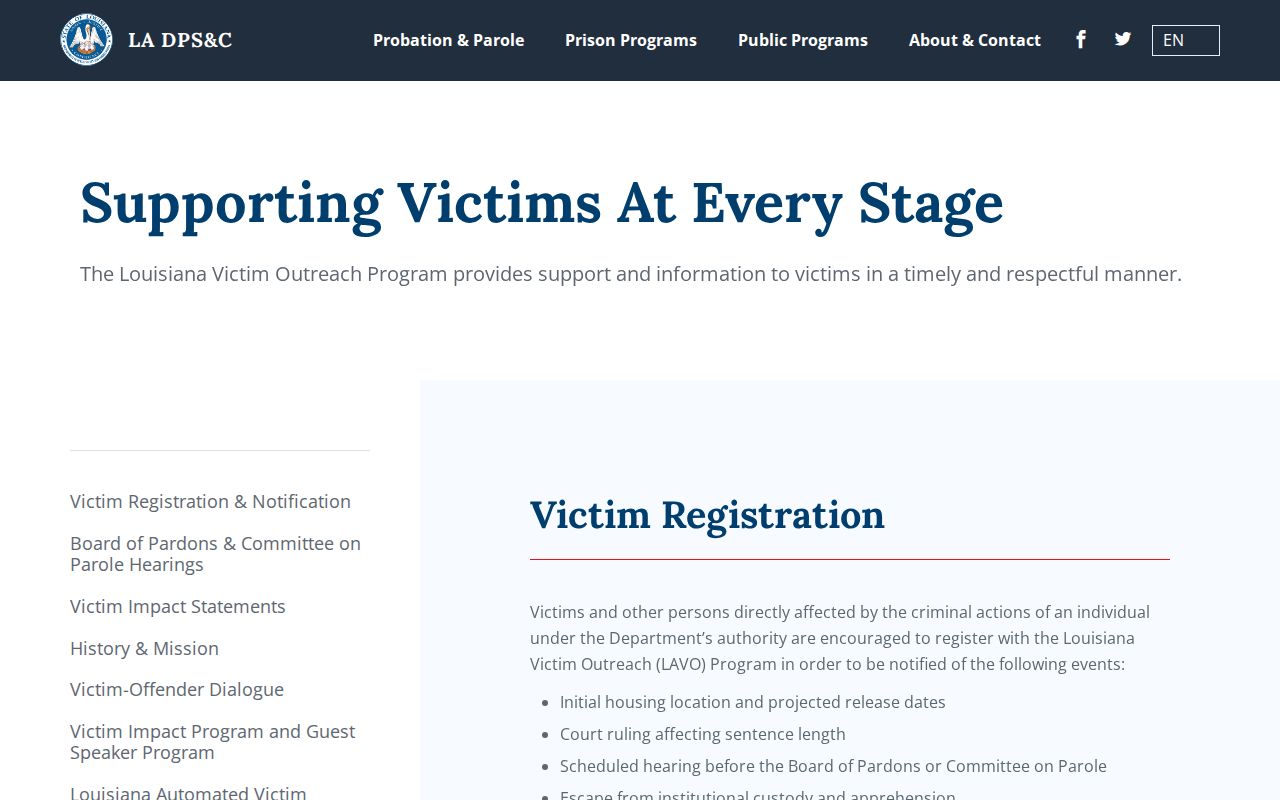
This distinction prevents a county-jail alert from being mistaken for complete state release-notice coverage.
Tensas VINE Release Confirmation Limits
VINELink is not the legal custodian. Data can lag because of an agency feed, delivery fault, or contact problem. VINE warns against relying only on automated information for safety decisions. A notice is a prompt to verify with Tensas Parish Detention Center, DPS&C, or the receiving agency. A no-match is equally limited.
Coverage ends at system borders. Use the BOP Inmate Locator for a federal prison sentence and ICE ODLS for current immigration detention. Neither a BOP “not in custody” result nor an ICE no-match proves unrestricted community release. The person may have transferred, completed one custodial segment, or fallen outside the database scope.
Important: Match two identifiers, quote the exact status, save the update time, and confirm a Tensas Parish release or transfer with the agency record.
For an old state discharge that VINELink no longer preserves, DPS&C accepts public-information requests. R.S. 15:574.12(G)(1)(a) makes certain general incarceration details, including discharge date, available on request. Ask narrowly with the person's name and DPS&C number.
Tensas VINE and Registry Records
The Louisiana State Police sex-offender registry is a separate, offense-limited source. It can show a person who lives in the community and has a legal registration duty, but it does not include all released people. It also does not establish the date, reason, or destination of a release. Use it only for the registration information it actually displays. Do not treat the registry as a substitute for the Tensas jail event, a DPS&C status, or the criminal case.
Identity matching remains essential across both systems. A shared name is not enough. Compare birth information and a state identifier when supplied. If the registry and VINE appear to describe different statuses, note each source's purpose and update date before contacting the responsible agency. One record may concern a registration duty while the other concerns custody or supervision. Those facts can coexist without contradiction.
A Tensas court record adds a third layer. It may show the disposition and sentence that led to custody or supervision. It still may not show the exact moment jail processing ended. The sheriff's release record remains the best local event source, while DPS&C supplies the state imprisonment, supervision, or discharge route. Keeping these roles distinct prevents one narrow database from being used to answer a broader question than it was built to answer.
What Tensas VINE Notices Prove
A saved notification is useful evidence of what the automated service reported at a given time. Preserve the message, date, delivery channel, reporting agency, and event wording. Then compare it with the source record. If it says transfer, ask for the receiving custodian. If it says release, ask whether the event was return to the community, movement into supervision, or release to another authority. If it reports parole, check current DPS&C supervision status rather than assuming full sentence discharge.
Telephone, text, email, and app delivery can fail for different reasons. A changed number, filtered message, expired account, or feed delay can interrupt notice even when registration was correct. Multiple offered methods reduce that risk, but none replaces direct agency contact. Keep the registration confirmation and update contact details. When a notice has not arrived near an expected event, revisit the matched record and call the agency shown there.
For Tensas parish custody, the detention center holds the authoritative booking and release event. For a DPS&C sentence, the state controls computation and state status. For a federal or immigration transfer, follow the named receiving system. VINE helps connect these stages, but the underlying custodian remains the final source.