
Tensas Projected and Actual Release
A projected release date is an administrative forecast based on the sentence and credits recorded at that time. Louisiana DPS&C says its telephone locator can provide that date when applicable. It does not certify that the person left on the stated day. An actual release record shows the completed custody event, its date and time, its reason, and whether the person entered the community or went to another custodian.
A pretrial Tensas detainee usually has no sentence-based date. Release can depend on bond, a recognizance order, dismissal, another court ruling, or resolution of a hold. A bond order authorizes release but does not show when jail processing ended. A dismissal on one case does not defeat a second case or detainer. Use the Tensas criminal minutes for legal authority and the sheriff's event for the physical exit.
Scheduled versus actual: A Tensas Parish projected release date forecasts a sentence event; only the jail or DPS&C record confirms a completed release or transfer.
Ask what the date means. Projected release, parole eligibility, projected good-time parole supervision, full-term date, and discharge are separate labels. Preserve the exact term rather than shortening each to “release date.”
Find Tensas Projected Release Dates
Classify custody first. For a state sentence, Louisiana DPS&C is the computation source even if the person is housed at Tensas Parish Detention Center. The Louisiana VINELink search can identify imprisonment or community supervision. The DPS&C telephone locator provides projected dates when applicable. Call 225-383-4580 with the DPS&C number, or legal name and date of birth.
For a parish sentence, call the detention center at 318-749-5810 and ask which local record holds the computation. Compare it with the Tensas Clerk criminal minutes, including sentence length, time-served credit, and concurrent or consecutive terms. For a pretrial case, ask for bond and hold status instead.
- Confirm name, birth date, booking number, or DPS&C number.
- Identify parish or DPS&C sentence authority.
- Read the judgment for sentence length, credit, and term structure.
- Ask the custodian for the exact named date and computation status.
- Ask whether official sentencing papers or later changes await entry.
- Recheck near the date and obtain the actual event afterward.
The DPS&C inmate-information page documents the locator route. Its terms should control any date description.
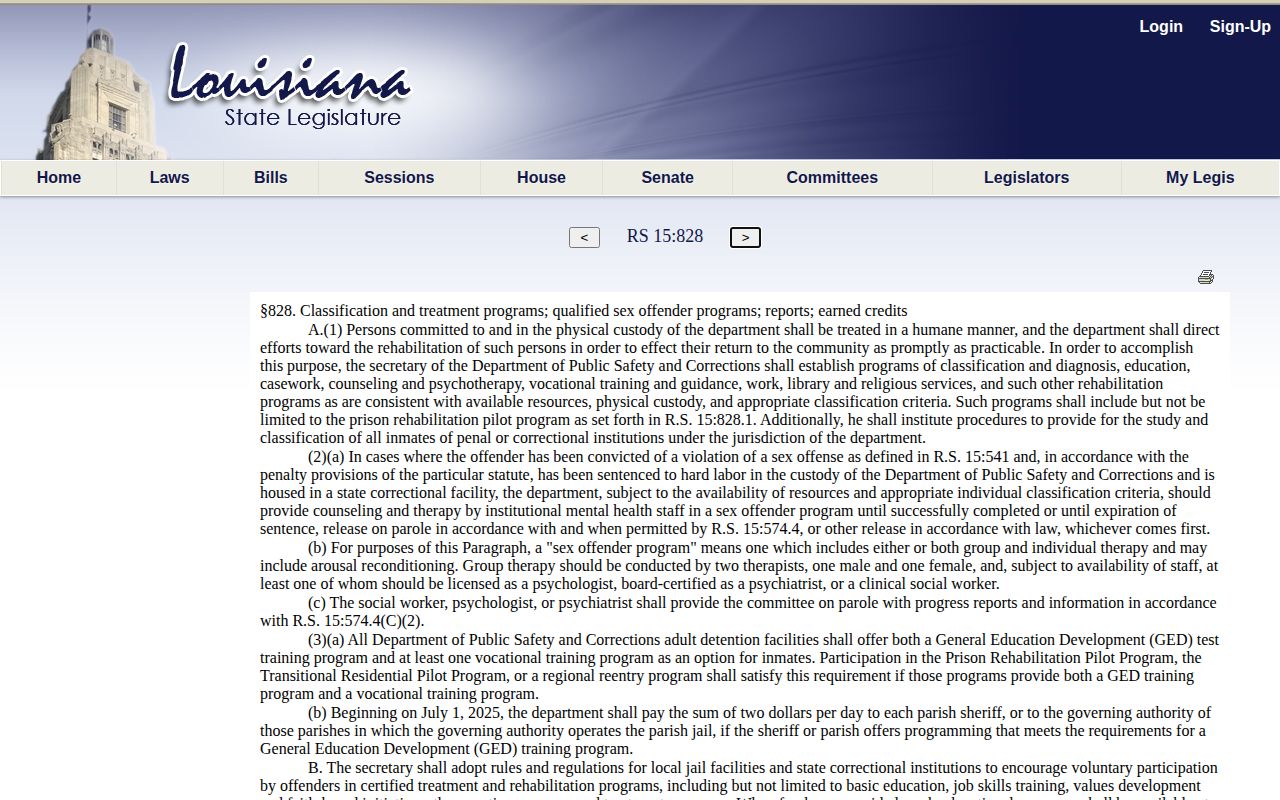
The related statutory screen shows why a projected good-time supervision date is not full discharge.
Tensas Good-Time Release Calculations
Computation starts with the sentence and applicable jail credit. It then accounts for concurrent or consecutive terms, offense-date law, eligibility for diminution, credit earned, forfeiture or restoration, program credit, and judgment changes. Diminution is a statutory reduction through earned credit. It is not a court reducing the sentence.
For offenses committed on or after August 1, 2024, R.S. 15:571.3.1 permits an eligible felony offender in parish prison or DPS&C custody to earn up to fifteen percent of the imposed sentence. The cited subsection excludes sex offenses as defined in R.S. 15:541 and habitual-offender sentences under R.S. 15:529.1. It permits eligible additional credit under R.S. 15:828, subjects credit to forfeiture, and gives the DPS&C secretary sole authority for covered computations. Diminution release generally places the unexpired term on unsupervised parole.
The common “85 percent” description comes from that maximum reduction. It is not a universal calculator. An excluded person may receive no reduction under that subsection. Program credits, consecutive terms, time-credit treatment, forfeitures, and offense-date law may yield another result. State only that eligible cases can receive up to the statutory maximum.
Earlier offenses may fall under R.S. 15:571.3. Its current text includes thirty-for-thirty diminution for certain parish prisoners and three-for-seventeen for a qualifying first crime of violence. The sheriff or qualifying superintendent can calculate eligible parish-sentence good time, while DPS&C controls state-sentence calculations.
Why Tensas Release Dates Change
A projected date moves when an input changes. DPS&C may lack a date until sentencing papers arrive. Later discipline, restored credit, program credit, an amended sentence, an appeal, a detainer, or parole action can alter timing or destination. Recalculation is a reason to contact the custodian, not reproduce its formula.
| Change | Effect to verify |
|---|---|
| Sentencing papers | A date may appear or change after the judgment arrives |
| Discipline | Earned credit may be forfeited under R.S. 15:571.4 |
| Programs | R.S. 15:828 credit may affect a supervision date |
| Court action | An amended judgment or credit order changes inputs |
| Detainer | The term may end while another agency assumes custody |
| Parole action | Eligibility, decision, prerequisites, and release differ |
R.S. 15:571.4 governs forfeiture in covered circumstances. R.S. 15:828 supplies program-credit rules and the phrase “projected good time parole supervision date.” Neither turns a charge label into a reliable calculation.
Tensas Parole and Good-Time Split
The 2024 changes require a distinction between discretionary parole and statutory good-time release. R.S. 15:574.22 states that a person committed to DPS&C for an offense committed on or after August 1, 2024 is not eligible for parole, apart from the juvenile and legacy-life provisions it cross-references. Separately, R.S. 15:571.3.1 permits eligible diminution and generally places the remaining term on unsupervised parole. Good-time release does not prove that the Committee on Parole granted a hearing.
For eligible earlier offenses, R.S. 15:574.4 has percentage rules based on offense classification, prior convictions, sentence, and other facts. Its framework includes a twenty-five-percent provision for some nonviolent cases and sixty-five percent for specified first crimes of violence, with many exclusions. Never calculate eligibility from a charge name alone.
Even a board grant is not actual release. R.S. 15:574.11 allows a date to be altered or rescinded before the parole certificate is signed and supervision begins. Confirm the agenda, decision, prerequisites, and DPS&C status in order.
Confirm Tensas Actual Release Dates
Recheck near the forecast. For a parish sentence, ask the jail for the completed event, exact time, reason code, and transfer destination. For a state sentence, review DPS&C status and request an actual discharge date if the public search does not preserve it. Community supervision means the person may be out of prison but still under sentence authority.
Registration through the Tensas Parish VINE inmate check can provide a custody-change alert. Read the event carefully. Release, transfer, escape, death, and parole differ. Louisiana Victim Outreach is a separate direct-registration route for eligible people seeking certain state projected and actual release notices, so local LAVNS registration is not complete state coverage.
A detainer can change only the destination. If Tensas or DPS&C releases its authority and another agency takes custody, the person was transferred, not released to the community. Record the receiving agency and continue there.
For completed state discharge, R.S. 15:574.12(G)(1)(a) makes specified general incarceration facts, including discharge date, available on request. A narrow DPS&C request should include the person's name and number and ask for that field. This is the final-record route once a projected date has passed.
Audit a Tensas Release-Date Record
A sound date check preserves the inputs instead of recording one unexplained number. Keep the judgment date, offense date, sentence length, court-ordered jail credit, term structure, governing statute, custodian, and the date the computation was observed. Ask whether the result reflects credit already earned or assumes future credit. If the answer is unclear, request the exact field label and the office's public explanation rather than trying to reverse-engineer the calculation.
Compare the Tensas court minutes with the custodian's record. A court order supplies the sentence and credit authority. The jail or DPS&C applies the governing computation. If the records differ, determine whether an amended judgment, delayed paperwork, forfeiture, or newly posted program credit accounts for the gap. Preserve both versions and their dates. A later computation may be valid without making the earlier observation false at the time it was recorded.
The destination deserves its own line. A release date may end the Tensas custody episode yet start probation, parole, unsupervised statutory supervision, or custody elsewhere. Ask whether any detainer is active and which agency will receive the person. This prevents a sentence-end forecast from being described as unrestricted community release.
Use the offense date, not the booking date, to select the governing good-time framework. They may fall in different legal periods. The conviction date is another separate fact. A single Tensas booking can also involve more than one charge or docket, and the sentences may run together or in sequence. Review every applicable judgment before accepting a computed end date. If one term is consecutive, completing the first term may not create a release event at all.
Parole eligibility dates need the same label discipline. Eligibility only permits consideration under the governing law. It is not a hearing decision. A favorable decision may still depend on prerequisites, and the committee retains authority to change action before actual entry into parole. When a source provides only eligibility, report only eligibility. Do not convert that date into a promised exit.
Save the name and role of the office that supplied each answer. A Tensas jail employee, clerk record, DPS&C locator response, and parole document may each address a different part of the timeline. Source labels make later updates easier to reconcile.
After the forecast passes, replace it with completed-event evidence. For local custody, request the booking number, release date and time, release code and definition, and transfer destination. For state custody, obtain the current imprisonment or supervision status and request the discharge date when applicable. Keep the projected date only as a historical calculation, clearly labeled with its observation date.